
The oldest Champagne house reintroduces a traditional method.
Philosophy of „sur liège“
«Il faut du temps chez nous, en Champagne, pour voir le grandes cuvées sortir enfin de nos caves. Ce millésime 2010 marque également un tournant. C’est l’occasion de découvrir l’empreinte d’une année dans un grand Blanc de Blanc vieillit sous liège» (Frédéric Panaoitis).
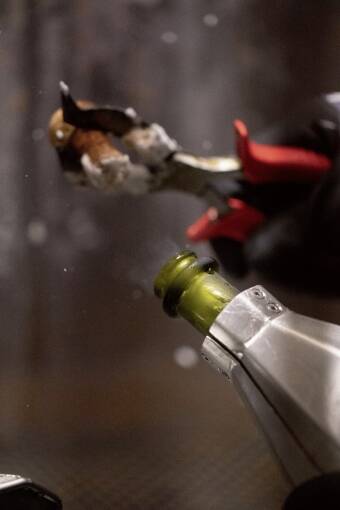
After ten years of ageing, it’s time for disgorging, a crucial stage that has now become manual once again. The operator removes the staple and pops the cork to release the deposit. A beautiful, technical gesture, applied to each bottle, now perennial once again thanks to the grace of Dom Ruinart 2010. The final touch: the addition of the liqueur sublimates the organoleptic aromas of this vintage extra-brut champagne, which will rest for a further year to enhance its exceptional flavor tenfold.
Ageing under cork instead of metal capsule
At the end of the 1990s, guided by an intuition, the cellar master decided to age part of the production of Dom Ruinart 1998 bottles under cork. Instead of the metal capsules commonly used, he opted for cork stoppers. Then, as usual, he let time do its work. When tasted in 2008, the difference was significant: the corked bottles produced tighter wines with an extra layer of complexity. Admittedly, this material is porous, but over the long term, it remains formidably stable. More so than metal capsules, which let oxygen through constantly and regularly every year.
With this cuvée, Ruinart reintroduces manual disgorging. A gesture made necessary once again by the tirage-liège and its staple. Today, it is carried out safely on a disgorging line entirely dedicated to Dom Ruinart cuvées.
Tasting notes Vintage 2013/ Vinification
The 2013 vintage impresses with its harmonious structure: fresh, clear Chardonnay notes are enriched by cork maturation and offer subtle depths and additional layers of aromas
COLOUR
At first glance, the champagne looks golden yellow, with light greenish hues and a fine, persistent sparkle.
THE NOSE
The wine presents a complex blend of fruity, roasted aromas accompanied by mineral and floral notes.
PALATE
The palate reveals lively citrus and spicy pepper nuances that emphasize the freshness and length of the wine.
Vinification
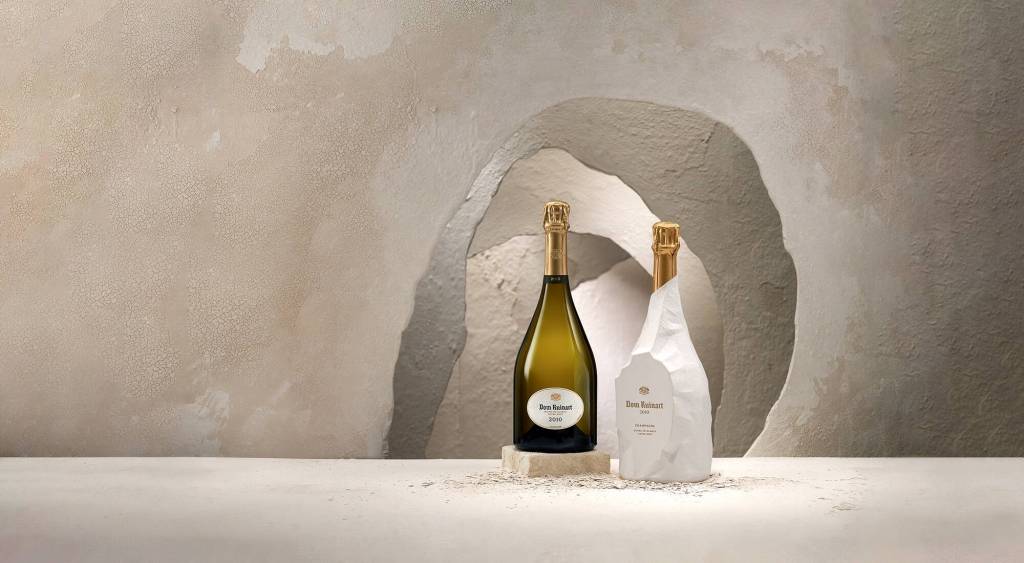
Dom Ruinart Blanc de Blancs 2013 is made exclusively from Grand Cru chardonnays, This iconic grape variety reflects the rich diversity of terroirs in the Champagne region and is present in all Maison Ruinart’s cuvées.
- Harvested by hand
- Grand Cru chardonnay blend: 70% from Côte des Blancs (Le Mesnil-sur-Oger, Avize, Chouilly & Bergères-lès Vertus) and 30% from Montagne de Reims (Verzenay, Sillery,Taissy, Villers-Marmery)
- Alcoholic fermentation in temperature-controlled stainless steel vats
- Malolactic fermentation
- Cork drawing ageing
- Disgorgement by hand
- Stacking by hand
- 10 years’ ageing on lees
- Dosage: 4 g/L
- It takes 10 years to produce this cuvée
- Contains sulphites
- Alcohol content – 12.5 % Vol.
- Temperature for perfect serving: 10-12°C
- Ageing potential up to 25 years at max. 15°C and humidity of +70%
Food Pairing
Dishes based purely on vegetables (potato, parsnip and mushroom gratin) or fish with firm meat (turbot) and oysters are perfect food pairings.

Tasting notes Vintage 2010 / Vinification
After a very cold winter, the year 2010 was characterized by a dry early summer and a rainy August. Harvesting began on August 15th. From the tasting of the base wines, the 2010 chardonnays surprised with their richness. A balance that allowed the oenological team to express all their know-how in the blend. It was the promise of a great vintage.
COLOUR
At first glance, the champagne looks golden yellow, with light greenish hues and a fine, persistent sparkle.
THE NOSE
The first nose reveals a powdery, floral and mineral note evoking the chypre universe of perfumery. The second nose brings together toasted and spicy notes such as nutmeg mace, roasted hazelnut and almond, and a hint of coffee.
PALATE
Fig leaf aromas mingle with notes of black tea and fresh spices in the mouth. A lingering fresh finish is elevated by an elegant bitterness.
Vinification
Dom Ruinart Blanc de Blancs 2010 is made exclusively from Grand Cru chardonnays, 90% of which are grown on the Côte des Blancs (Le Mesnil-sur-Oger, Avize, Chouilly and Cramant) and 10% on the Montagne de Reims (Sillery). This iconic grape variety reflects the rich diversity of terroirs in the Champagne region and is present in all Maison Ruinart’s cuvées.
- Harvested by hand
- Grand Cru chardonnay blend
- Alcoholic fermentation in temperature-controlled stainless steel vats
- Malolactic fermentation
- Cork drawing ageing
- Disgorgement by hand
- Stacking by hand
- At least 9 years’ ageing on lees
- Dosage: 4 g/L
- It takes 12 years to produce this cuvée
- Contains sulphites
- Alcohol content – 12.5 % Vol.
- Temperature for perfect serving: 10-12°C
- Ageing potential up to 25 years at max. 17°C and humidity of +70%
Food Pairing
Spicy roast dishes, seafood, poultry such as:
grilled sea bass, grilled prawns, smoked blue lobster, smoked sturgeon, tatare of oysters, grilled corn-fed chicken with fennel and orange, iberico ham, black pork tenderloin, goat cheese with roasted figs on balsamico dressing
Dom Ruinart Blanc de Blanc 2010 was named best champagne in the world
 Wein verstehen & geniessen
4 Antworten zu “What is so special about „tirage à liège“ ?”
[…] Prestige Cuvée of maison Ruinart, produces a Blanc de Blancs redescovering ancient techniques (read more). Known for its finesse , fullness and complexity. Aged for at least 9 years on the lees. Dosage of […]
LikeLike
[…] dass man für das Hefelager einen provisorischen Zapfen aus Kork verwendet. Man spricht dann von tirage sous liège (Lagerung auf Kork), wodurch es bereits während des Hefelagers zu einem minimen […]
LikeLike
[…] Reifung auf der Hefe mit Korken: tirage à liège […]
LikeLike
[…] Reifung auf der Hefe mit Korken: tirage à liège […]
LikeLike