Climate change is a significant concern for the entire wine industry. The shifting climate poses substantial challenges, necessitating adaptation and the implementation of sustainable practices in both vineyard management and winemaking.
Climate changes are evident in the vineyards and even perceptible in the wine’s taste. The Champagne region, traditionally known for its cool climate, is warming towards a temperate climate. Sudden temperature fluctuations, such as the frosts experienced in 2021, can devastate crops. Once rare, these occurrences are becoming increasingly common. Additionally, very hot summers with minimal rainfall are leading to shorter ripening periods, causing a discrepancy between technological maturity (sugar/acid balance) and physiological maturity (tannins, pips, and aromas). This, in turn, alters the flavors of the grapes.
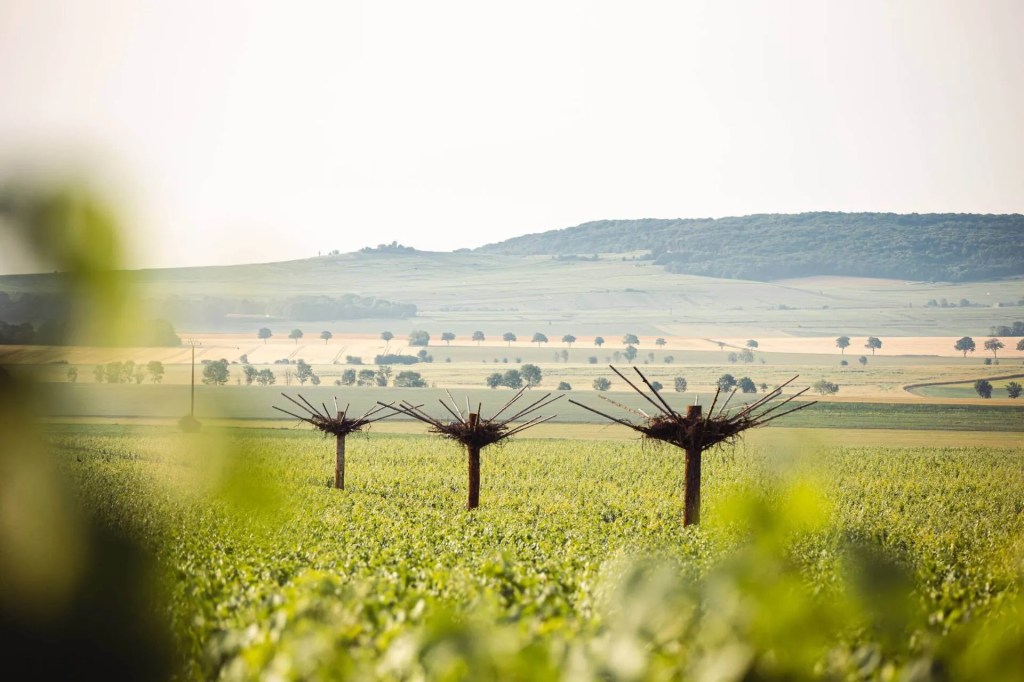
The impact of climate change
Climate change has significantly impacted the Champagne growing region:
- Temperature Rise: Increased average temperatures can lead to over-ripening of grapes, higher sugar levels, and lower acidity, which can affect the traditional taste profile of Champagne.
- Early Budburst and Harvest: Warmer temperatures cause earlier budburst and harvest times, which can make vines more susceptible to spring frosts and result in a compressed growing season.
- Extreme Weather Events: More frequent extreme weather events such as hailstorms, frosts, and heavy rains can damage vines, reduce yields, and impact grape quality.
- Water Stress: Changes in precipitation patterns, including prolonged droughts or irregular rainfall, can lead to water stress for vines, affecting their health and the development of grapes.
- Pests and Diseases: Warmer temperatures and changing humidity levels can increase the prevalence of pests and diseases, necessitating more vigilant vineyard management and potentially more chemical interventions.
- Soil Erosion and Degradation: Intense rainfall and extreme weather can lead to soil erosion and degradation, impacting vine health and sustainability of the vineyards.
- Phenological Shifts: Changes in the timing of phenological stages (e.g., flowering, veraison) can disrupt the balance between sugar, acid, and phenolic ripeness, challenging winemakers to maintain the desired quality and the Maison style of Champagne.
(Re) Craft
“Savoir (Re) faire” – an invitation to reflect on current ecological issues such as:
- Preserve the nature for future generations
- Promote biodiversity
- Sustainable viticulture
- Reduction of use of chemicals
- Reduce carbon footprint
Champagne depends on nature. It is the role and duty of everybody involved in the industry to protect it. The figures speak for themselves. Extreme summers like 1964, 1976 and 1982 are now very common. Since 2003, seven harvests have started in August – since 2017, there have only been early pickings. But that’s not all. Because flowering, but not budding, is also taking place earlier and earlier, night frosts are occurring more and more frequently, with fatal consequences for vines and fruit set. If it were up to the Huglin heat sum index, Grenache or Syrah would have to be planted in Champagne today. But start to plant innovative and diffferent grape varieties is not an option in Champagne (only Chardonnay, Pinot noir, Meunier, Arbane, Petit Meslier, Pinot blanc and Pinot Gris are authorized) and overall the region has thight boundaries to its terroir and strict regulations. So at this moment, the main question for a winemaker of a Maison for is: create a completly new style to adapt to climate change or keep the core of Maison’s style adapting the work in the wineyards, the processes and the assemblage?
„Climate change has a huge impact on the vineyard and requires Maison Ruinart to rethink its methods. As a witness to the temperamental force of nature, the Ruinart Blanc Singulier cuvée has become a symbol of climate change, perpetuating the pioneering spirit of a Maison that blends tradition and innovation.“ F. Panaïotis
A new cuvée as an answer
Cellar Master Frédéric Panaïotis of Maison Ruinart and his teams have identified the emergence of new aromatic profiles linked to this new climate paradigm. These differences have in particular led to new balances between the aromatic profiles – fruity, floral, vegetal, spice – coupled with an intense expression and particularly powerful texture. Now Ruinart is revealing these new characteristics, adapting its savoir-faire while retaining the Maison’s distinctive signature, culminating in the creation of a cuvée named Blanc Singulier.
Like the iconic Ruinart Blanc de Blancs, the new Blanc Singulier is a 100% chardonnay cuvée. The atypical climate profile of the year will thus shape a distinctive aromatic expression.

The prototype of Blanc Singulier is “Edition 17”, the first experimental version by the cellar master. It marks the starting point of the dedicated reserve. Ruinart Blanc Singulier Edition 17 is exclusively available for tasting and purchase at Maison Ruinart in Reims.
The second release, the „Edition 18“, stands as a testimony to the climatic variations encountered by our vines throughout the year 2018. Benefiting from a warm and sun-drenched season, the vine’s vegetative cycle accelerated significantly, leading to an early and bountiful harvest commencing in August. These distinctive weather conditions brought forth diverse aromatic profiles.
The Ruinart Blanc Singulier „Edition 19“ joins the collection of cuvée editions, each reflecting the variations of a year marked by extreme climatic conditions. The year 2019, characterised by three intense summer heatwaves (23 days with temperatures above 30°C) and a record temperature (42.9°C vs 42°C in 2003), is emblematic of climatic upheavals. Thanks to a warm and sunny season, the vine’s vegetative cycle was very rapid, and the ripe and early harvest began as early as August.
The 2019 edition shows the beautiful elegance and reductive freshness of the house, with the classic floral and lemony notes of Chardonnay. It certainly stands out from the trio with its radiant acidity and enormous freshness with beautiful complexity. Available directly from Maison, click here.
The future of Blanc de Blancs
In fact, Panaïotis has already announced that there will not be a Blanc Singulier every year. But in the medium and long term, the cellar master is convinced that Blanc Singulier, which is currently only produced in small quantities, will one day replace the classic Blanc de Blancs. It embodies the future of Champagne not only through its content, but also through its packaging – the cotton fibre label, the plastic-free foil and the dark, recyclable bottle glass.
How are other Champagne houses dealing with this?
Soon you will be able to read more here about the effects of climate change on viticulture and the reduction carbon footprint on a business perspective…. stay tuned. Yours, Sandro
Links:
https://edition.cnn.com/2023/12/28/climate/new-year-champagne-weather-threat-climate/index.html
 Wein verstehen & geniessen